Key Takeaways
- Sensors act as the “senses” of a robot, allowing it to perceive and interact with the physical world.
- Learning to use sensors teaches kids the “Input-Process-Output” framework essential to all engineering.
- Kids develop conditional logic skills by programming robots to react differently to various environmental triggers.
- Using sensors transforms a basic machine into an autonomous system capable of making its own decisions.
In the world of robotics, motors provide the muscle, and code provides the brain—but sensors provide the superpowers. Without sensors, a robot is “blind” and “deaf,” moving only in pre-programmed patterns regardless of what is happening around it. When kids learn to integrate sensors into their builds, they stop just moving parts and start designing intelligent systems.
Giving Robots a Sense of the World
At OhmsKids, we introduce students to various electronic components that mimic human senses. By doing so, we bridge the gap between biological concepts and engineering reality:
- Ultrasonic Sensors (Sight/Distance): Just like bats using echolocation, these sensors allow a robot to “see” how far away an object is. Kids learn to code “stop-and-avoid” behaviors, which is the foundational logic used in self-driving cars.
- Color Sensors (Vision/Pattern): These allow robots to follow lines or sort objects by color. This teaches kids about data input—how a machine perceives a physical property and converts it into a digital value.
- Touch Sensors (Feeling): These trigger an action when a robot physically bumps into something, teaching the engineering concept of “tactile feedback.”
The Logic of “If-Then” Thinking
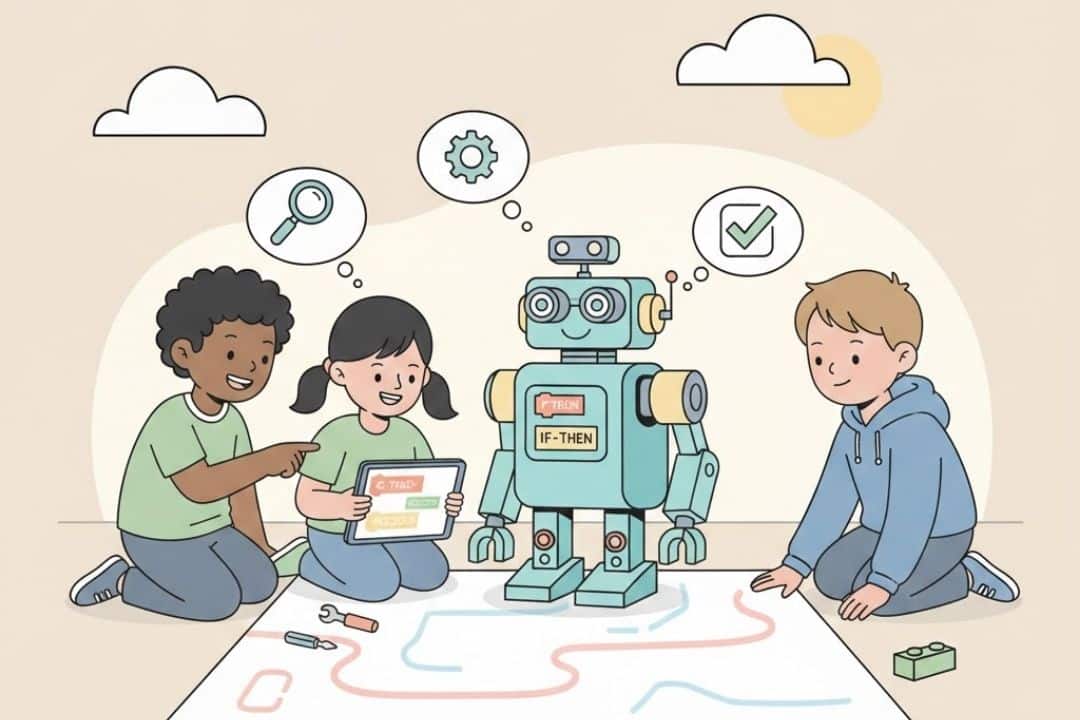
The true value of sensors isn’t just the hardware; it’s the logic they require. To use a sensor, a child must master conditional statements.
Engineer-in-training must think through scenarios: “If the distance to the wall is less than 10cm, then stop the motors. Else, keep moving forward.” This way of thinking is the backbone of all automation. It teaches children to anticipate problems, account for variables, and build “fail-safes” into their designs.
From Manual Control to Autonomy
When a child builds a remote-controlled robot, they are the ones making the decisions. When they add sensors, they delegate that decision-making to the robot itself. This shift from manual to autonomous is a massive milestone in a young engineer’s development.
It forces them to ask deeper questions: What happens if the lighting changes? What if the floor is slippery? By troubleshooting these real-world variables, kids move beyond basic assembly and begin to understand the complexities of systems engineering. They realize that a great engineer doesn’t just build a machine; they build a machine that can “think” for itself.