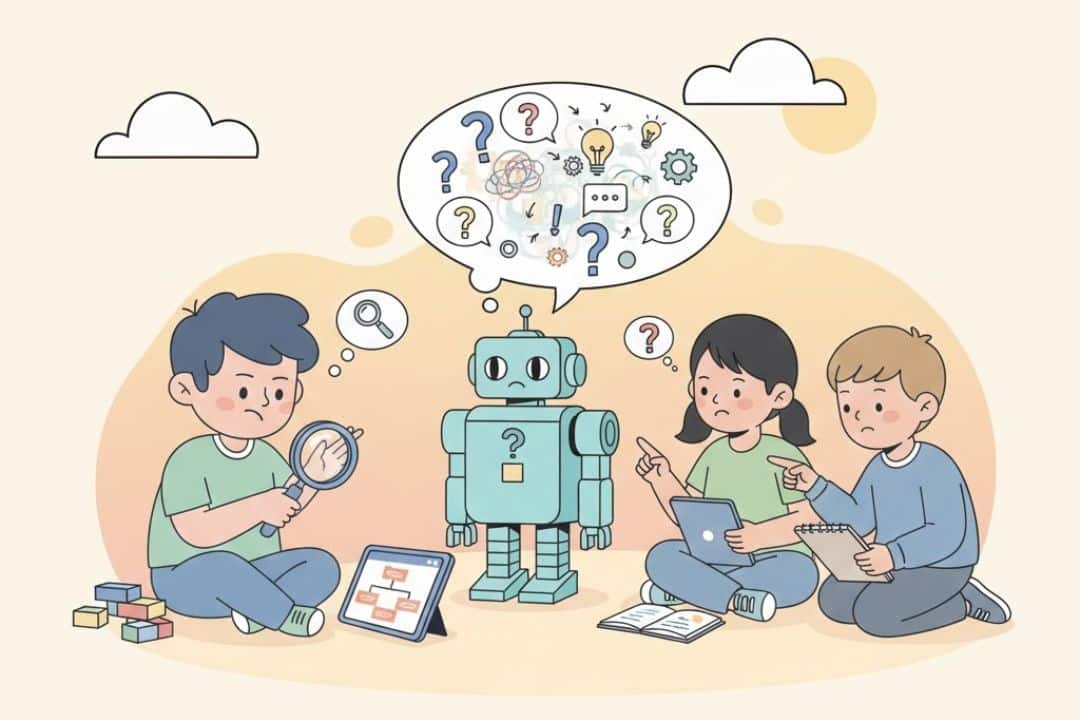
Key Takeaways
- Encouraging kids to ask “why” and “how” questions deepens their understanding beyond surface-level answers.
- Framing mistakes as opportunities for inquiry helps children explore solutions creatively.
- OhmsKids fosters a learning environment where questioning is celebrated and essential for discovery.
- Developing strong questioning skills empowers children to become independent learners and innovators.
In traditional education, success is often measured by how well a child can provide the correct answer. But in today’s rapidly evolving world, the ability to ask better questions is arguably a far more powerful skill. At OhmsKids Coding Class in Singapore, we believe that true learning begins not with an answer, but with a curious “Why?” or a probing “How?”.
Teaching kids to formulate effective questions transforms them from passive recipients of information into active investigators and critical thinkers.
The Power of “Why?” and “How?”
Think about a robot that isn’t moving correctly. A child who is only focused on answers might say, “It’s broken.” But a child who is trained to ask better questions might ask:
- “Why isn’t it moving? Is the battery dead?”
- “How does the code tell it to move? Did I miss a step?”
- “What if I change this sensor? Will that make a difference?”
These types of questions are the bedrock of problem-solving and innovation. They encourage:
- Deeper Understanding: Instead of just accepting a fact, kids dig into the underlying reasons and mechanisms. This is crucial whether they’re learning about how coding powers robots or the complexities of cloud computing.
- Critical Thinking: Asking good questions requires analysis, synthesis, and evaluation – the higher-order thinking skills that define true intelligence.
- Creative Problem-Solving: When confronted with a challenge, children who can ask the right questions are better equipped to explore multiple solutions, rather than getting stuck on the first apparent roadblock.
Fostering an Inquiry-Based Learning Environment
At OhmsKids, our educators are trained to facilitate rather than just dictate. We use several strategies to encourage a culture of questioning:
- “I Don’t Know, Let’s Find Out”: When a child asks a complex question, we often turn it back to them as a shared investigation. This teaches them that it’s okay not to have all the answers and that the learning journey is collaborative.
- Embracing Mistakes as Questions: Instead of seeing a bug in code as a “failure,” we frame it as a question: “What is this bug trying to tell us?” This empowers kids to approach challenges with curiosity, a skill honed during the debugging process.
- The “Five Whys” Technique: For persistent problems, we guide children through asking “why” five times in a row. This helps them peel back layers of symptoms to get to the root cause, a technique vital for the iterative design process.
By consistently encouraging profound inquiry, we don’t just teach kids coding or robotics; we teach them how to learn. We equip them with the intellectual tools to dissect problems, generate new ideas, and confidently navigate a world that demands continuous questioning and innovation.